A Poor Mimic
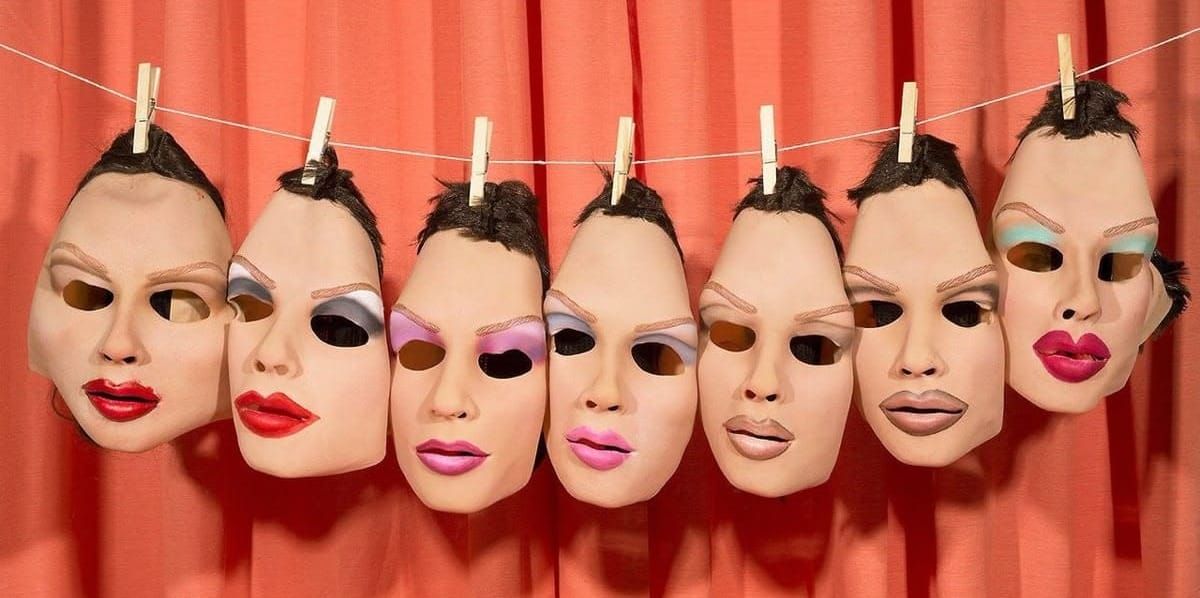
I spent most of my teens and twenties trying to be a person other people could stand, and I was terrible at it. Genuinely bad. Whatever the instinct is that lets someone read a room and adjust? I don't have the factory version. I had to build one by hand, badly, out of observation and guesswork.
What nobody warns you about is that getting good at it is worse.
Bad camouflage is forgivable. People are generous to a girl who's clearly trying and clearly failing; it costs them nothing. But a woman who can actually move? Who can be quiet all day and then say the thing nobody else will say, from across the room, and go right back to her book. That's not awkwardness anymore. That's control. And nobody has ever been comfortable around a woman who's demonstrated control.
I should start earlier.
I was five, sitting at the kitchen table with my father and a book neither of us wanted to be holding. I got stuck on a word. I was sounding it out. I still remember the shape of my mouth around it. Somewhere around the third second he said "stupid," and that was that.
In second grade my teacher wanted me moved up. She'd called on me to read aloud to the class and was surprised when the tone of my voice gave away that I understood the meaning behind each word, not just its sound. So they tested me. Elaborate testing, the kind with a specialist, a folder, and a stack of questions nobody would explain the purpose of.
Reading comprehension at a college level. That's what they said.
I want to tell you that fixed it. But a diagnosis of "gifted" at seven doesn't outrank a father at five. The folder saying how special I was went in a drawer, and the word stayed exactly where he'd put it, and it made room for the others: lazy, selfish, mean, angry, abrasive, weird.
Seven words. In rotation since roughly the year I learned to talk.
Here is what I understand now that I couldn't have understood then: none of those words were descriptions. They were translations.
I didn't like being touched. I didn't want to be held or hugged or gathered up, and the adults around me translated that into she doesn't love us. Which is a remarkable thing to do to a four-year-old. To take a nervous system and read it as a verdict.
I asked why. Constantly, and about everything. If I didn't understand a rule I challenged it, because why would I do something when I couldn't see the point of doing it? That got translated as defiant. Nobody considered that a child who needs a reason is a child who will follow the reason once she has it.
I was nine the day my father was called to come get me out of the Sunday school classroom. How do we know Jesus is real? I'd asked. Because we feel him in our hearts, she said. "Yeah, but how do we actually know?"
They phoned him immediately.
I didn't understand other kids. Not in a precocious way, not in the insufferable old soul way. I want to be clear that I wasn't a small adult trapped in the wrong body. I just couldn't parse them. Whatever they were all running on, I hadn't been issued a copy. They annoyed me the way a language you don't speak annoys you when you're stuck in the middle of it all day. Not the people. The exclusion. Not because you want them to speak your language, but because you so desperately want to be able to speak theirs. To understand the words that get a laugh. To get in on the connection forming three feet away from you and just out of reach.
Adults annoyed me too, but I could follow adults. So I became the kid who ate lunch with the teacher. In junior high my P.E. teacher, Mrs. Vetise, taught me guitar during lunch in the auditorium. I was bad at P.E. and worse at the fifty other things happening on that blacktop, and I've spent years telling this story as she took pity on me.
I'd like to revise that. Pity is an hour of somebody's Tuesday. She gave me an hour a day and taught me an instrument. It wasn’t pity, not even close. It was pure recognition, and it says something about the shape I'd been given that my first instinct, twenty years on, is to translate a woman's regard for me into charity.
I wasn't "not like other girls". I was "there's just something off about her". You either loved me or you couldn't stand me, and both camps were confident. That is still true, by the way. It's the most durable fact of my life.
So I tried to fix it.
I studied. I dressed the way the other girls dressed once I understood there was a uniform of coolness that could get me by. Fashion, beauty, and hours of any History or Discovery Channel show remotely related to anthropology or sociology became my special interests. I was sloppy at first, but I got pretty good.
Hug people even if you don't want to. Laugh even if you don't think it's funny. Don't say what you're actually thinking. Don't be yourself. Lie. Say you like the band even though you've never heard them. Say you saw the movie even if you hadn't. Hide. Hide, and hide some more. Those were my daily affirmations.
What I learned in that period is that mimicry has a tell. You can assemble a passable person out of parts, you can watch what works for other people and copy the mechanism, but it runs about a half-second behind. You laugh a beat late. You agree with something before you've finished hearing it. You perform an interest so thoroughly that the performance itself becomes the strange thing in the room.
People can't always name it. But they clock it. And the thing they clock isn't she's pretending. It's something's off, which is where we started, so I'd gone all the way around and paid full price for the trip.
I did plenty in those years that was worth disliking. I learned, ill-advisedly, that gossip was currency. To my brain I wasn't gossiping, I was just saying the truth; if the thing I was saying was true about someone, then it was fine to say, and people loved the information. I was a sweet summer child then. So unaware. I lost friends, learned to play the part better, got them back. Rinse and repeat until there was no more repeat.
I hurt people constantly. Not because I wanted to and not because I was inherently selfish, but because I was always calculating what it was people wanted from me and how I could best appease them, and that taught me dishonesty.
I could lay out the entire ledger, every wrongdoing of my life, but I'm not building a case for my own innocence here. I'm telling you that the effort was enormous, the results were poor, and everyone involved could tell.
There are two ways to change shape, and for most of my life I only knew about one of them.
I wear both of them on a chain around my neck.
Medusa's shape was done to her. A punishment handed down and worn permanently, and the terms were: you will now have a face that nobody can look at. The part I keep turning over is that the story gets told as though the monstrousness were the crime. As though she'd chosen it. She's remembered as a thing to be killed, the killing is remembered as heroism, and almost nobody asks who did the transforming or why.
That's the shape I grew up in. Assigned, not chosen. Seven words handed to a child who had no competing account and no standing to argue, and then a whole life spent being treated as though I'd picked them out myself.
The Morrigan changes shape too. Crow, eel, wolf, heifer, an old woman washing armor at a ford, a young one appearing on the road with an offer. But here's the distinction that took me thirty years to find: she isn't in disguise. She's not pretending to be a crow so the crows will accept her. Every shape is hers. She isn't hiding in any of them.
People call it camouflage. I've come to think of it as sovereignty. It's the difference between changing so you'll be tolerated and changing because you contain more than one thing.
I got good at it eventually. Not at pretending; I never got good at pretending. At moving.
I can be quiet through an entire conversation and then say the thing, from across the room, and return to my book. I can end an argument and be finished with it. Actually finished, not swallowing it, not filing it away for later. The thing was said, it was handled, I'm done. I can be soft with people and I can be the most intimidating presence in a room without intending to be either. I don't laugh at jokes I don't find funny. I've never been one for watercooler talk. If you're someone who wants coddling, I can promise you I'm not your girl.
None of this is performance. That's precisely what makes people uneasy.
I still love fashion. I dress how I want now, which is not the same thing as dressing how they dressed. I still love anthropology, and there's a thirty-page thesis sitting on my hard drive that isn't worth anything without a degree. Or so they say. Another folder in another drawer. I'm trying to go back for it.
I still do the thing the studying taught me, too. Patterns, alignments, watching how the pieces of a group arrange themselves and why. I picked it up as a survival mechanism and kept it because it turned out to be the most interesting thing about being alive.
I've been an on-and-off green witch for years, and I'm only now getting comfortable enough to just live in it. Which makes me laugh, because that's the same little girl who played alone in the backyard making potions out of twigs and leaves instead of having anyone over. She preferred it that way. She still does.
I didn't become anything. I went back.
And I'll be honest: it lands worse than the failing did. When I was bad at this, people found me strange but manageable. Now they find me cold. Which is funny, because cold is what they called the child who wouldn't be hugged. Same word, opposite cause, and nobody has ever once stopped to check which one they were looking at.
Stupid. Lazy. Selfish. Mean. Angry. Abrasive. Weird.
I've stopped disputing the list. Some of it was never true, some of it was true for a while, and one or two I've decided to keep. Call me weird and I'll agree with you. I am, I always have been, and it suits me. Call me abrasive and I'll agree with that too; I've never had the skill of being the bigger guy. What I no longer accept is the authorship. Those words were assigned to a child who couldn't cross-examine them, by people who were describing their own discomfort and calling it my character.
The Morrigan doesn't explain herself to the men at the ford. She tells them what's coming and she leaves, and they call her a bad omen. She was never the omen, just the only one willing to say it out loud.
I'm not asking to be understood. I stopped asking a while ago.
But I'd like the record to show that I was never any good at being someone else, and that lifelong failure is the best thing about me.